
Preparing Athletes for the Realities of Modern Competitive Sport
A systematic mental skills training platform that supports focus, regulation, confidence, and consistency under pressure.
Choose your role below to see how The Athlete’s Mental Blueprint helps athletes build the mental skills needed in high-pressure, competitive environments.
This training can be used by individual athletes, supported by parents, integrated by coaches, or adopted at the organizational level.
Train the skills that help you execute, adapt, and recover when performance is being evaluated.
Support your athlete in developing confidence, focus, and resilience without adding pressure or unrealistic expectations.
Integrate mental skills into everyday coaching to support consistent execution and response under pressure.
Implement a systematic mental performance framework that supports athletes across training, competition, and evaluation.
The Mental Performance Gap in Modern Sport
Competitive sport looks very different today than it did even a decade ago.
Athletes are navigating longer seasons with fewer true breaks, increased visibility through social media, constant evaluation, and in many cases new pressures tied to recruiting, NIL, and public comparison.
As competition intensifies, opportunities are increasingly shaped by how athletes manage focus, decision-making, and emotional responses in high-pressure moments, not just how talented or prepared they are. Without the skills to regulate attention, recover quickly from mistakes, and adapt under scrutiny, even highly capable athletes can experience inconsistency, frustration, and eventual burnout.
Across youth, high school, and collegiate sport, this gap shows up in familiar ways:
Athletes who look confident and capable in practice but tighten up in competition
Performance swings tied to mistakes, expectations, or external pressure
Mental fatigue, loss of enjoyment, or burnout in environments with constant demands and little recovery

The issue is not effort, motivation, or physical preparation.
It reflects the growing mental and emotional demands athletes face in modern sport, and the need for skills that help them stay grounded, engaged, and adaptable as those demands increase.
While sports science has transformed physical training and tactical preparation, the mental demands of modern sport have largely been left to informal conversations, personality traits, or trial-and-error learning. As a result, athletes are often asked to perform under constant evaluation without ever being taught how to regulate attention, respond to mistakes, or adapt their decision-making in those conditions.
When this gap exists, pressure does not create problems.
It exposes what has not been trained.
And in those moments, how coaches and leaders respond often determines whether athletes learn to stabilize their performance, or repeat the same breakdowns.
What Parents, Athletes, and Coaches Are Seeing Under Pressure
Across elite high school and collegiate sport, the same patterns show up repeatedly.
Athletes who train well and care deeply often struggle to bring the same execution into competition when expectations rise and outcomes feel more consequential.
Mistakes linger.
Attention narrows.
Decision-making becomes reactive rather than adaptive.
Coaches and parents often observe:
Strong practice performance followed by inconsistency in competition
Athletes playing tighter as expectations increase
Difficulty resetting after mistakes or critical moments
Focus drifting when outcomes feel consequential
These patterns are not a sign that athletes lack toughness or care too much.
They reflect athletes operating in highly evaluative environments without being taught how to regulate attention, emotion, and response.
When this gap goes unaddressed, the cost is real:
Untapped potential despite ability and effort
Missed opportunities at key transition points
Talented athletes becoming frustrated, disengaged, or burned out
Introducing...

A Systematic Approach to Training Performance Under Pressure
At the highest levels of sport, physical preparation is expected.
What separates consistent performers from inconsistent ones is not effort or motivation, but how athletes are trained to respond when performance is being evaluated.
The Athlete’s Mental Blueprint is a systematic mental skills training framework designed to support the development of athletes who must perform in environments where execution, decision-making, and emotional control are constantly tested.
Whether integrated into team settings, used by individual athletes, or supported by parents and coaches, AMB develops the capacity to:
Regulate attention and emotion in high-pressure moments
Recover quickly after mistakes
Execute skills consistently when outcomes matter
Rather than treating mental skills as abstract traits or motivational concepts, AMB approaches them as trainable behaviors that can be applied across practice, competition, and everyday performance demands.
The result is not only improved performance under pressure, but athletes who are better equipped to sustain confidence, engagement, and resilience across demanding seasons and developmental transitions.
The Five Core Mental Skill Sets Athletes Needs in High-Pressure Environments
The Athlete’s Mental Blueprint is grounded in decades of research in sport psychology, performance science, and applied mental skills training.
Rather than treating mental toughness as a personality trait or something athletes either have or do not have, AMB focuses on five key sets of trainable mental skills that shape how athletes function when pressure increases.
Emotional and Attentional Regulation
Athletes learn how to manage their emotional responses, attention, and physiological activation so they can execute what they have trained, even when stress is high.
This supports steadier decision-making, faster recovery after mistakes, and greater composure under evaluation.
Responding to Pressure and Challenge
Athletes learn how to interpret pressure situations, setbacks, and adversity in ways that encourage engagement rather than avoidance.
This influences whether athletes compete assertively or play cautiously when expectations rise.
Sustaining Effort and Engagement
Athletes develop skills to stay committed and invested across demanding training cycles, long seasons, and changing roles.
This protects against burnout, emotional withdrawal, and performance drop-off over time.
Building Stable Confidence
Athletes learn how confidence is built, maintained, and protected through preparation and evidence rather than outcomes alone.
This allows athletes to trust their skills and compete freely, even when results fluctuate.
Direction, Focus, and Self-Regulated Progress
Athletes learn how to set effective goals, track progress, and stay oriented toward improvement rather than becoming reactive to short-term results.
This supports motivation, clarity, and resilience during setbacks or plateaus.
When these mental skill sets are trained together, athletes are better equipped to handle the realities of modern competitive sport.
Performance becomes more consistent.
Emotional swings become less disruptive.
Pressure becomes something athletes can function inside rather than something that overwhelms them.
How the Training is Structured
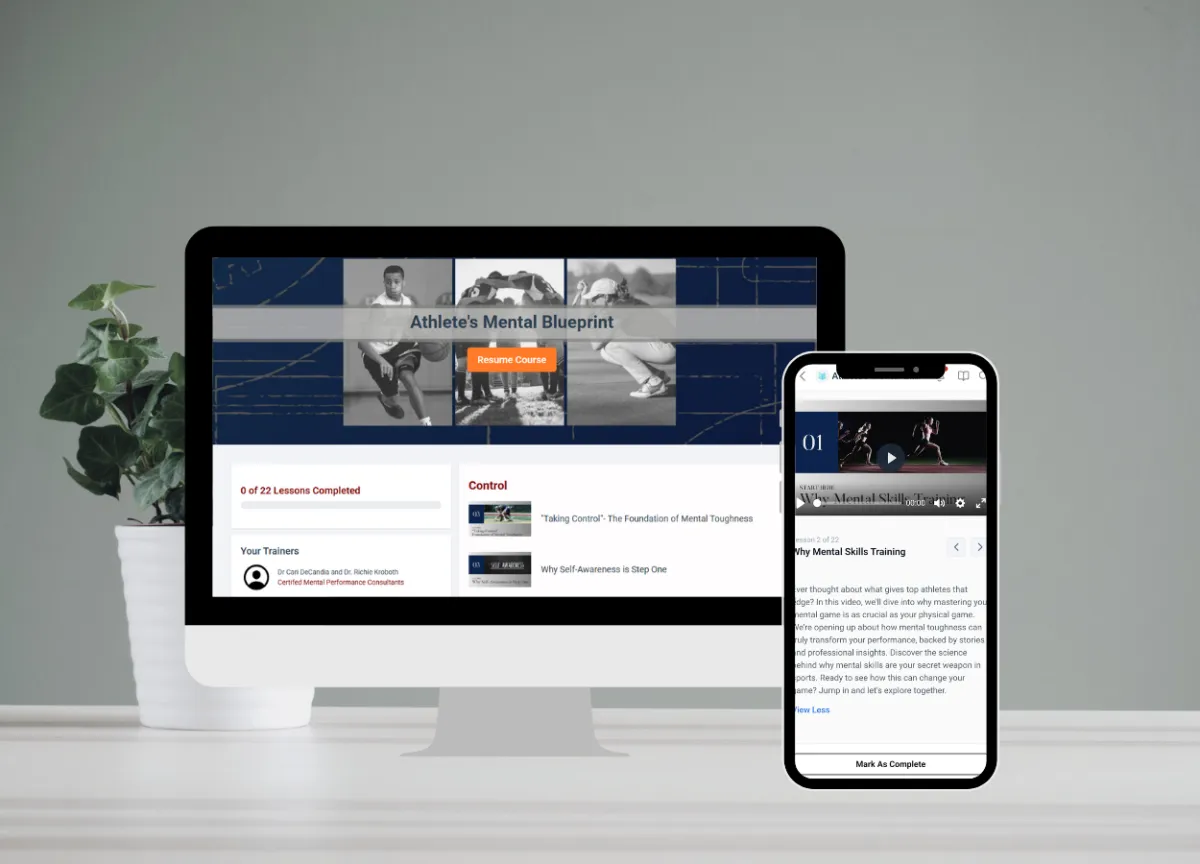
Athlete’s Mental Blueprint is delivered as a progressive training system, designed to help athletes apply mental skills consistently across practice, competition, and evaluation settings.
Rather than one-off lessons or motivational content, the training combines structured learning, guided application, and ongoing support.
Comprehensive Training Modules
5 Complete training modules, available on demand
20+ Short video lessons focused on applied performance skills
Hands-on exercises that help athletes integrate concepts into training and competition
Real-world scenarios drawn from high-pressure sport environements
On-going Expert Support
Monthly live training sessions led by Certified Mental Performance Consultants
Interactive Q&A focused on real performance challenges athletes and teams face
Advanced topics that deepen skill application over time
Performance-Focused Community
Private training platform for athletes committed to improving performance under pressure
Guided discussions and challenges that reinforce learning and accountability.
"Once all of the physical training is done, it is the mind that determines how well an athlete executes."
-Peter Haberl (US Olympic Committee)
What Others Have to Say About the Mental Game in Sport...
"Don't be afraid of failure. This is the way to succeed."
-Lebron James

"I'm not the next Usain Bolt or Michael Phelps. I'm the first Simone Biles."
-Simone Biles

"The most important attribute a player must have is mental toughness."
-Mia Hamm

"Good teams become great ones when the members trust each other enough to surrender the 'Me' for the 'We'."
-Phil Jackson

Learn more based on your role
The Athlete’s Mental Blueprint supports athletes, parents, coaches, and organizations in different ways.
Train the skills that help you execute, adapt, and recover when performance is being evaluated.
Support your athlete in developing confidence, focus, and resilience without adding pressure or unrealistic expectations.
Integrate mental skills into everyday coaching to support consistent execution and response under pressure.
Implement a systematic mental performance framework that supports athletes across training, competition, and evaluation.
Partner With Athlete's Mental Blueprint
Athlete’s Mental Blueprint partners with coaches, consultants, and organizations who are committed to developing consistent performance under pressure, not just talent or motivation.
Our Partner Program is designed for those who want to integrate systematic mental skills training into the environments they lead, support, or serve.


